Category: Uncategorized

  • Pre-Stretch, Explained: How the Percentage on Your Wrapper Decides Film Cost

    Pre-Stretch, Explained: How the Percentage on Your Wrapper Decides Film Cost

    Two warehouses can wrap identical pallets, buy film at the same price per pound, and end up with monthly stretch-film bills that differ by a third. The variable that usually explains the gap is not the film itself but how far it gets stretched before it touches the load. Pre-stretch is the least glamorous number in the stretch-wrap spec and one of the most financially significant. Understanding it is the difference between buying film and buying the coverage the film can actually deliver.

    What pre-stretch actually means

    Pre-stretch is the amount film is elongated before it is applied to the load, expressed as a percentage of its original length. A carriage set to 200% pre-stretch takes one foot of film and elongates it to three feet before it wraps the pallet. The film leaves the roll short and thick and arrives on the load long and thin, having done most of its stretching inside the machine rather than by brute tension against the corners of the freight.

    This is fundamentally different from simply pulling film tight by hand. Hand-applied conventional film rarely achieves meaningful elongation, because a person cannot generate consistent tension wrap after wrap. A powered pre-stretch carriage, by contrast, stretches the film against a set of geared rollers to a precise, repeatable percentage. That precision is what makes pre-stretch a spec you can actually plan around rather than a variable that drifts with whoever is running the wrapper that shift.

    The yield math: one foot off the roll, several feet on the load

    The economic case for pre-stretch is pure arithmetic. At 150% pre-stretch, every linear foot coming off the roll becomes about 2.5 feet on the load. At 300%, that same foot becomes roughly 4 feet. In other words, raising pre-stretch from 150% to 300% lets one roll cover substantially more pallets before it runs out, because you are drawing far less film off the core to deliver the same wrap.
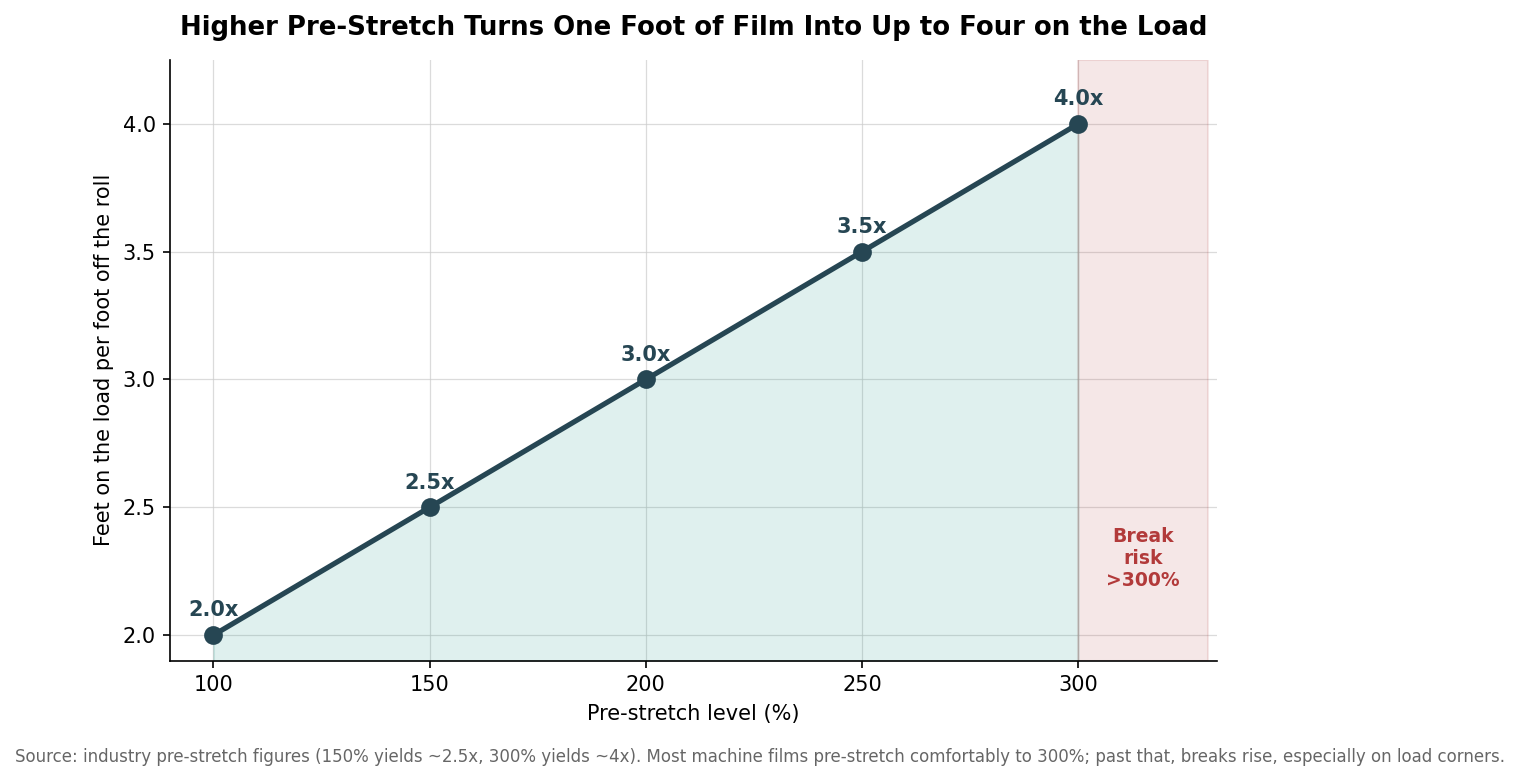
    Line chart showing film yield rising from 2x at 100 percent pre-stretch to 4x at 300 percent, with a break-risk zone beyond
    Yield climbs with pre-stretch: one foot off the roll becomes 2.5 feet on the load at 150% and about 4 feet at 300%.

    Flip the arithmetic around and the purchasing implication becomes obvious. To lay a given length of film onto a load, a higher pre-stretch level pulls dramatically fewer feet off the roll. The second chart shows the same relationship from the buyer’s side: putting a fixed amount of film on the load costs 50 feet off the roll at 100% pre-stretch but only 25 feet at 300%. Since you pay for the feet on the roll, not the feet on the load, that is where the savings live. Across a facility wrapping hundreds of pallets a day, moving up the pre-stretch curve is commonly cited as cutting film consumption by 20% to 30%.
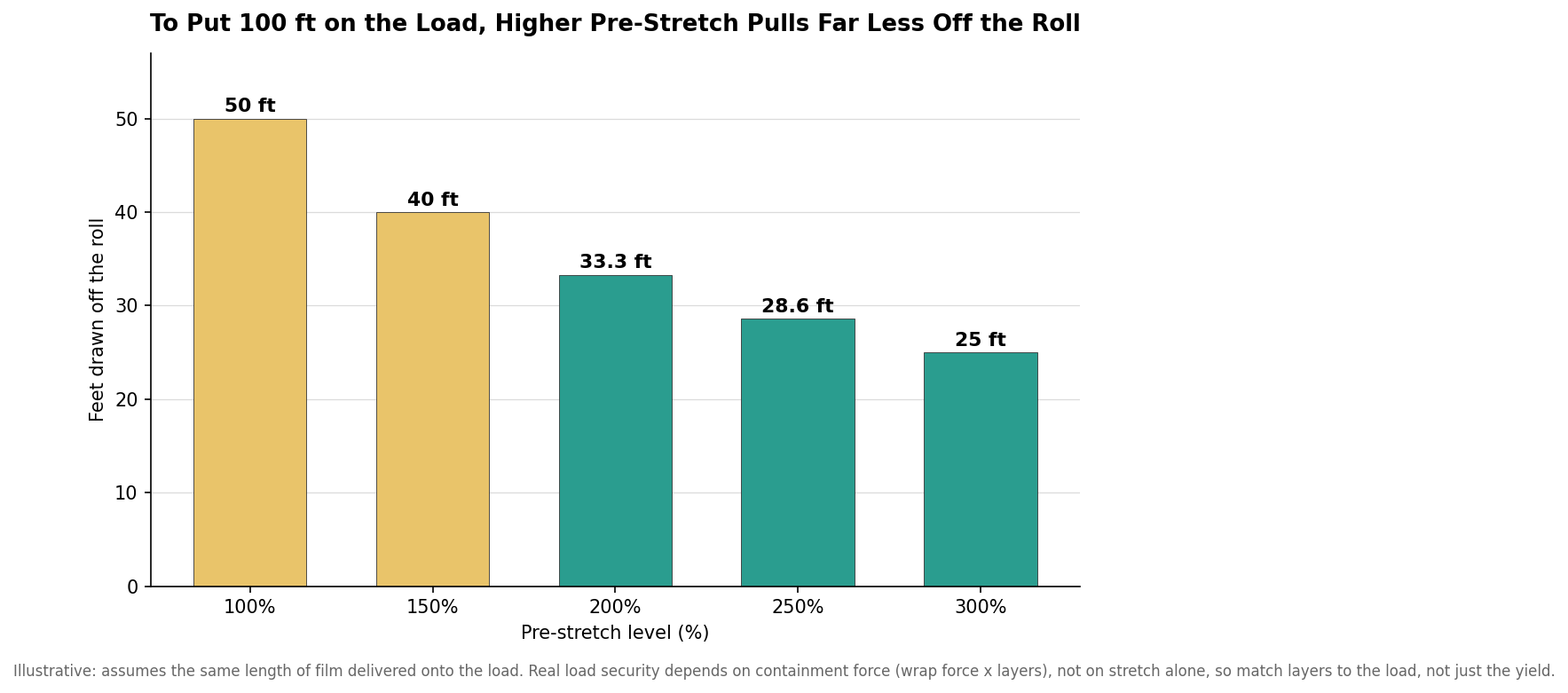
    Bar chart showing feet of film drawn off the roll to place 100 feet on the load, falling from 50 feet to 25 feet as pre-stretch rises
    Delivering the same film onto the load pulls half as much off the roll at 300% pre-stretch as at 100%.

    Where the 150 to 300 percent range comes from

    Most machine films sold today are engineered to pre-stretch comfortably up to 300%. The usable band runs from roughly 150% at the conservative end to 300% at the aggressive end, and the setting is typically fixed by the gears in the wrapper’s pre-stretch carriage rather than dialed in by the operator. Films are formulated with the resins and layer structure needed to survive that elongation without necking down to the point of tearing.

    There is a ceiling, and it is real. Push past 300% and film begins to break more often, particularly at the corners of the load, where a pre-stretched web is already near the limit of its tension and the geometry concentrates stress. Chasing an extra few points of yield at 320% or 340% tends to backfire: a film break mid-cycle stops the line, leaves a partially wrapped pallet, and wastes the film already applied. The practical target for most operations is to run the highest pre-stretch the film and load will tolerate reliably, then stop, rather than to maximize the number on paper.

    The catch: pre-stretch saves film, containment force secures the load

    Here is the nuance that trips up buyers who treat pre-stretch as a proxy for load security. Stretching the film is not what holds the load together. Load stability is governed by containment force, which is the product of wrap force and the number of film layers. A tightly pre-stretched single layer and a moderately stretched double layer can deliver the same containment force, and it is that force, applied through enough revolutions, that keeps boxes from shifting in transit.

    What pre-stretch does is let you reach a given containment force using less film mass, because the thinned, elongated film still contributes wrap force per layer. The mistake is assuming that maxing out pre-stretch automatically produces a secure pallet. If you thin the film aggressively but do not apply enough wraps, you can end up with a beautifully economical wrap job that fails a freight-claim test. Pre-stretch is a cost lever; layer count and wrap force are the security levers, and they have to be set together.

    How to choose a pre-stretch level and spec film for it

    Start from the load, not the yield target. A light, stable, boxy pallet tolerates high pre-stretch and few layers, so it is the ideal candidate for pushing toward 250% or 300% and capturing the film savings. A heavy, unstable, or sharp-cornered load needs more containment force and often a tougher film, which may mean running pre-stretch a notch lower to preserve puncture resistance and avoid breaks at the edges. Match the film’s rated pre-stretch capability to the setting on your carriage; a film formulated for 200% will not survive a 300% carriage, and running a high-performance film at a low setting leaves savings on the table.

    When you specify film, ask for its recommended pre-stretch range and its performance at that range, not just its gauge or micron rating. A thinner film run at high pre-stretch can outperform a thicker film run poorly, because effective performance comes from how the film is applied as much as from how much material is in it. Set the carriage to the highest level the load runs reliably, confirm containment force with enough wraps to pass your own drop or tilt test, and let the yield math do the rest. Done deliberately, pre-stretch is the rare packaging decision that cuts cost and improves consistency at the same time.
  • Blown vs. Cast Stretch Film: Which Pallet Wrap Your Loads Actually Need

    Blown vs. Cast Stretch Film: Which Pallet Wrap Your Loads Actually Need

    Two rolls of stretch film can look identical on the rack and behave nothing alike once they hit a load. The difference usually comes down to how the film was made. Cast and blown are the two manufacturing methods behind nearly all pallet wrap, and the choice between them decides how well a load holds, how the film sounds coming off the roll, whether a scanner can read a label through it, and how much you spend per pallet. Understanding the two processes is the difference between buying film by price alone and buying the film your loads actually need.

    Two ways to make the same-looking film

    Cast film is extruded through a flat slot die and cooled quickly against a chilled roller. That rapid, even cooling produces film with consistent thickness, high clarity, and a quiet, easy release from the roll. Blown film is made by forcing molten resin through a circular die and inflating it into a vertical bubble that cools in the air. The slower, less controlled cooling scrambles the polymer structure in a way that makes the finished film tougher, but also hazier, noisier, and more expensive to produce because the line runs slower.

    Neither process is a premium or budget version of the other. They are different tools. Cast dominates the market, by many industry estimates something like seventy to eighty percent of stretch film sold, largely because it runs cheaply at high speed and suits automated wrapping. Blown holds its ground wherever raw toughness and load retention matter more than clarity or cost. The rest of the decision follows from those origins, because almost every property that separates the two films on the loading dock traces directly back to how the polymer cooled when it was made.

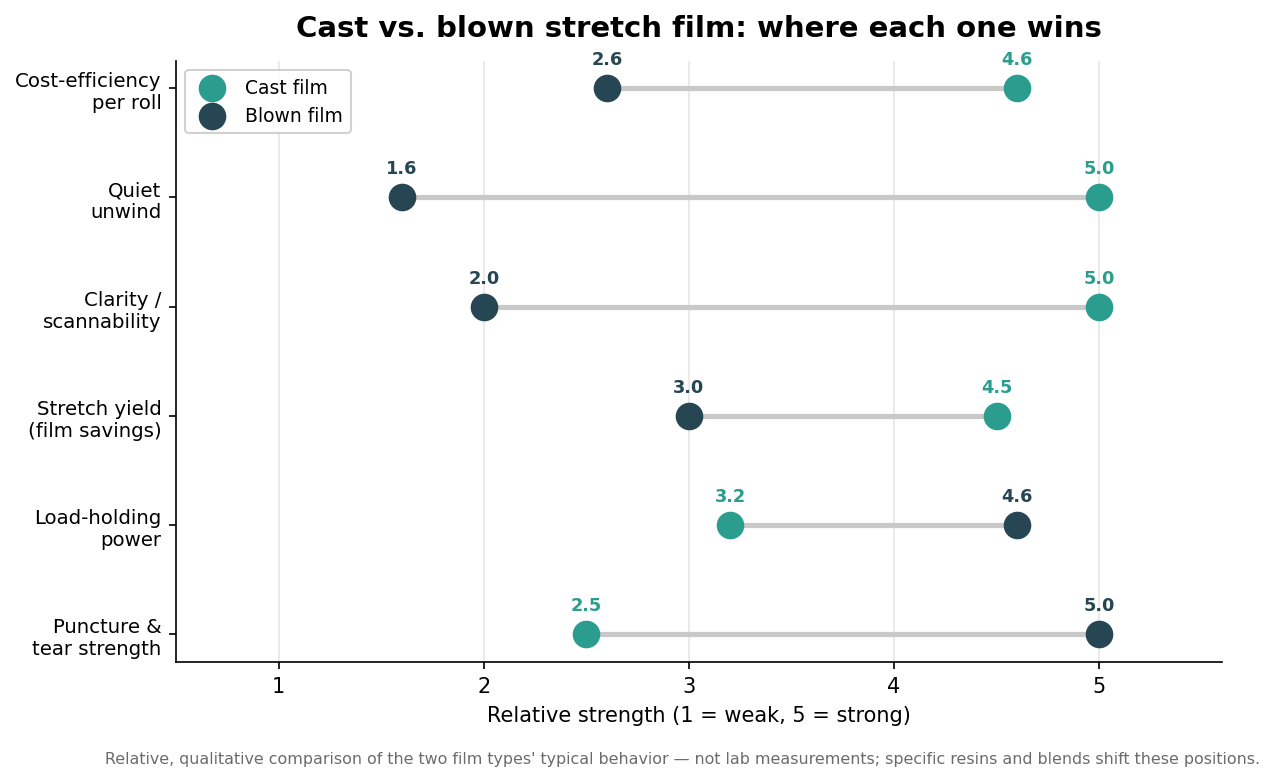
    It is worth naming the properties that matter before comparing them, because a spec sheet rarely spells them out. Puncture and tear resistance govern whether the wrap survives a sharp corner. Holding force, sometimes called load retention, is how firmly the film pulls a load together and keeps it there through handling and transit. Clarity decides whether labels scan through the wrap. Unwind noise and hand feel affect operators on long shifts. And stretch yield, how far the film elongates before it fails, quietly sets how many pallets a roll actually wraps. Cast and blown land differently on every one of these.

    Dumbbell chart comparing cast and blown stretch film on puncture strength, load holding, stretch yield, clarity, quiet unwind and cost
    Cast wins on clarity, quiet unwind, stretch yield and roll cost; blown wins on puncture strength and load-holding power.

    What each film does better on the load

    Blown film’s headline strength is strength itself. Its molecular structure gives it superior puncture and tear resistance, so it stands up to sharp corners, exposed hardware, lumber, and irregular loads that would tear cast film under tension. It also has more holding power and memory: once applied it resists re-stretching and pulls back against a shifting load, which is why it is favored where stability is critical. Its cling is typically one-sided, so wrapped pallets do not stick to each other in transit, an underrated advantage when loads are staged tightly.

    Cast film answers with clarity, quiet, and yield. It comes off the roll crystal clear, so barcodes and labels stay scannable through the wrap without cutting into it. It unwinds quietly, which matters in noise-sensitive shifts and reduces operator fatigue during long hand-wrapping runs. It usually carries two-sided cling, which helps layers grip themselves as they overlap. And it stretches further before failing, which, as the next chart shows, is where a lot of the real cost lives.

    Why stretch yield quietly controls the cost

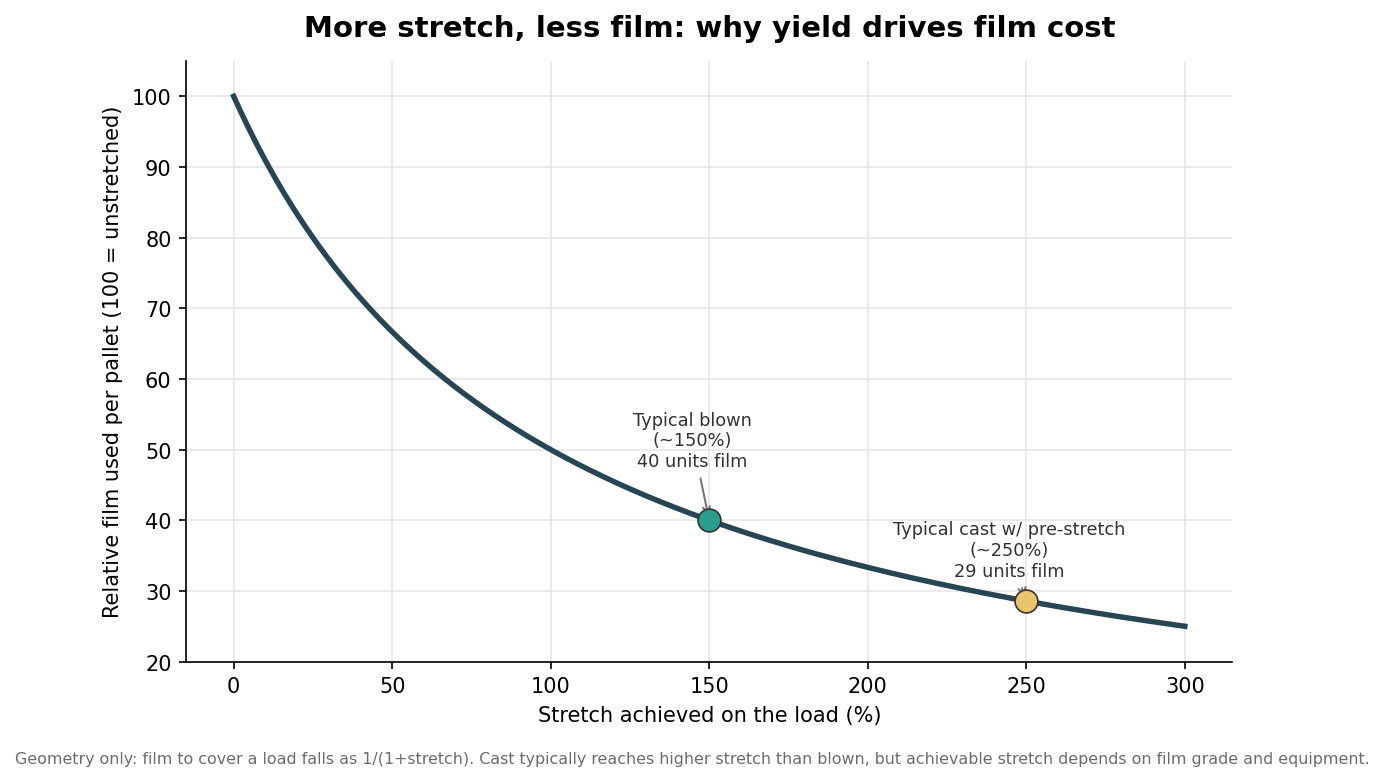
    The sticker price of a roll is only part of what film costs. The bigger number is how many pallets that roll wraps, and that is governed by how far the film stretches. Because the amount of film needed to cover a load falls roughly as one divided by one plus the stretch ratio, pushing film from no stretch to 150 percent cuts the linear film per pallet to around 40 percent of the unstretched amount, and reaching 250 percent cuts it to under 30 percent. Cast film’s greater stretchability is what lets a warehouse chase those higher numbers, especially with powered pre-stretch equipment.

    Line chart showing relative stretch film used per pallet falling as stretch percentage increases, with typical blown and cast points
    Film used per pallet falls sharply as stretch rises, which is why a film’s achievable stretch drives its true cost per load.

    The figures above are geometry, not a promise: the curve describes how film coverage scales with stretch, but the stretch a given film can actually achieve depends on its grade, its thickness, and the machine applying it. The practical lesson holds regardless. A cheaper roll that cannot stretch as far can easily cost more per pallet than a pricier roll that does, because you wrap fewer loads from it. Comparing film on price per roll rather than cost per pallet is the most common way warehouses overpay, and it usually favors the wrong film.

    How to specify the right one for your loads

    Start from the load, not the film. If your pallets have sharp edges, heavy or dense contents, or irregular shapes that concentrate stress, blown film’s puncture resistance and holding power are worth its higher price and its noise, because a single failed wrap and a toppled load costs far more than the film. If your loads are uniform, stable, and boxed, and especially if labels need to be scanned through the wrap or you are running an automated wrapper, cast film’s clarity, quiet unwind, and higher stretch yield make it the more economical and practical choice for the majority of general warehousing.

    Two habits sharpen the decision. Compare candidates on cost per wrapped pallet rather than price per roll, factoring in the stretch each film reliably reaches on your equipment, and match the gauge to the load weight rather than defaulting to the thickest film on hand. Get the process and the yield right and the film line stops being a commodity purchase and becomes a lever on both load integrity and freight cost. The specific stretch numbers and market shares here are indicative and worth confirming against current supplier data, but the underlying trade-off, toughness versus clarity, cost, and yield, is stable enough to build a specification around.

  • How to Wrap a Pallet Correctly: Technique, Containment Force, and Film Economics

    How to Wrap a Pallet Correctly: Technique, Containment Force, and Film Economics

    A pallet that arrives leaning, shifted, or collapsed is rarely the fault of the film. It is almost always the fault of how the film was applied. Stretch wrapping looks like the simplest job on the dock, which is exactly why it gets done badly: too few turns at the base, no real tension, and a load that separates from the pallet the first time a forklift stops short. Wrapping a pallet correctly is a repeatable technique, and once a crew learns it, damage claims and reruns drop noticeably. Here is how to do it properly, plus the two numbers that decide whether a load actually holds.

    Start with a stable load, not the film

    No amount of wrapping rescues a badly built stack. Build the load square, with the heaviest and largest boxes on the bottom and lighter items on top, and keep every box inside the footprint of the pallet. Overhang is the enemy: a carton that hangs past the pallet edge loses its corner protection, and film pulled over that overhang tends to tear. Interlock or column-stack the boxes for stability, fill obvious voids so the load cannot shift into them, and make sure the top is reasonably flat so the film has something to grip. If the load is not stable standing still on the dock, it will not survive being wrapped and shipped.

    The wrap, step by step

    Begin at the bottom. Anchor the film to the pallet by threading a corner of the sheet through the pallet or twisting it into a rope and tucking it in, so the wrap is tied to the pallet itself rather than just to the boxes. This first connection is what stops the load from sliding off the deck in transit. Wrap the base three to four full revolutions, keeping the film low enough to catch the pallet, because the bottom wraps do most of the work of holding the load down.

    From there, spiral upward in overlapping passes, letting each layer cover about 50 percent of the one below it so there are no unwrapped bands. Keep steady tension the whole way up; on a manual roll, starting around 50 percent of the film’s stretch is a reasonable default, dropping toward 20 percent when the boxes are crushable. When you reach the top, put two to three revolutions around the uppermost layer and carry three to six inches of film over the top edge of the boxes to lock the crown of the load. Then spiral back down to reinforce and return to the base, and tuck or twist off the tail rather than letting it flap loose. For heavier or taller loads, twisting the film into a rope for a pass or two, sometimes called roping or cabling, concentrates the force and pulls the top of the load in tight.

    Containment force: the number that decides if it holds

    The single most useful concept in pallet wrapping is containment force, and most people have never measured theirs. Containment force is the total holding force the film applies to the load, measured in pounds, and it equals wrap tightness multiplied by the number of revolutions at a given point on the load. Two turns of tight film and four turns of loose film can produce completely different results, which is why “just wrap it a few times” is not a spec.

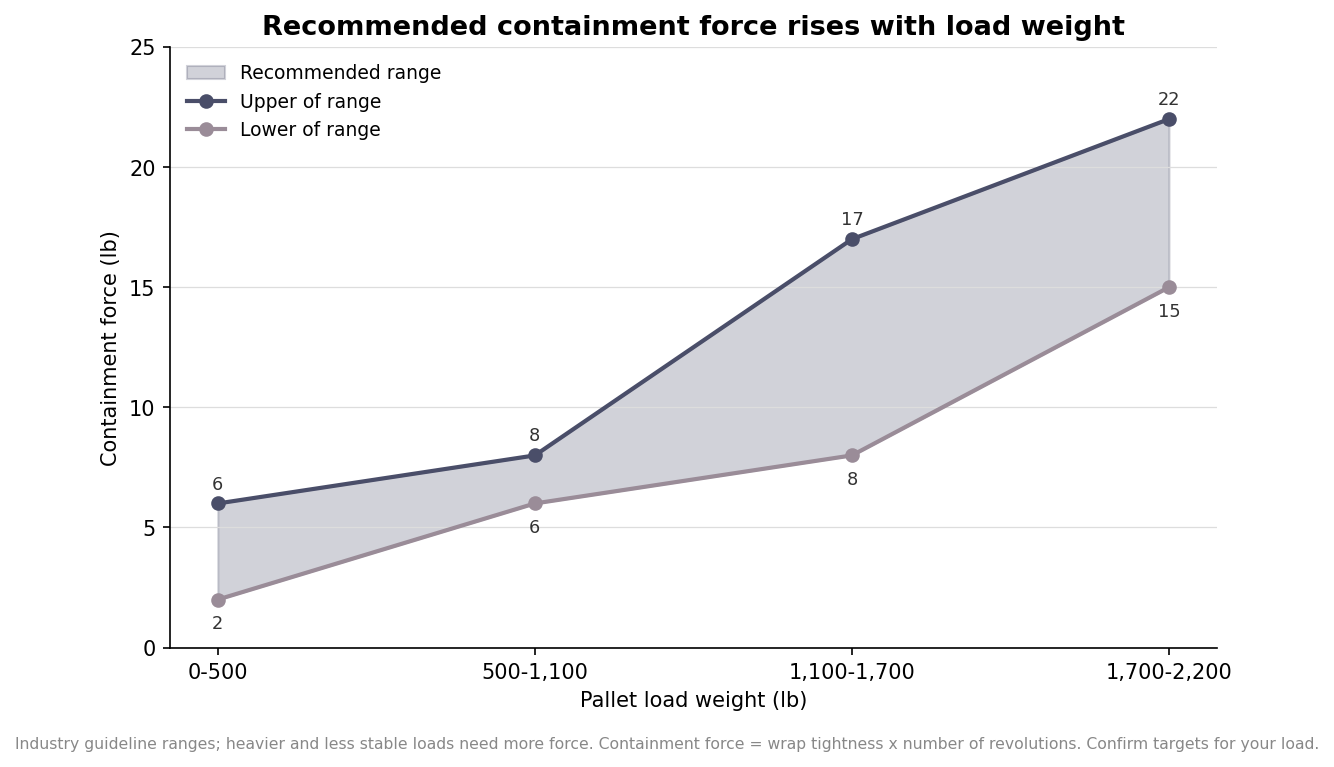
    How much you need scales with the weight and stability of the load. As a rough industry guideline, light loads up to about 500 pounds call for roughly 2 to 6 pounds of containment force, standard loads in the 500-to-1,100-pound range want about 6 to 8 pounds, heavier loads up to 1,700 pounds want 8 to 17 pounds, and very heavy or unstable loads push into the 15-to-22-pound range. The chart below shows how that recommended window climbs with load weight. Treat these as starting points and confirm the right target for your specific product, since a fragile load and a dense, stable one of the same weight behave differently.

    Band chart showing recommended stretch wrap containment force in pounds rising with pallet load weight from light to very heavy loads
    Recommended containment force windows climb with load weight; heavier and less stable loads need more force.

    Prestretch and the cost of the film you use

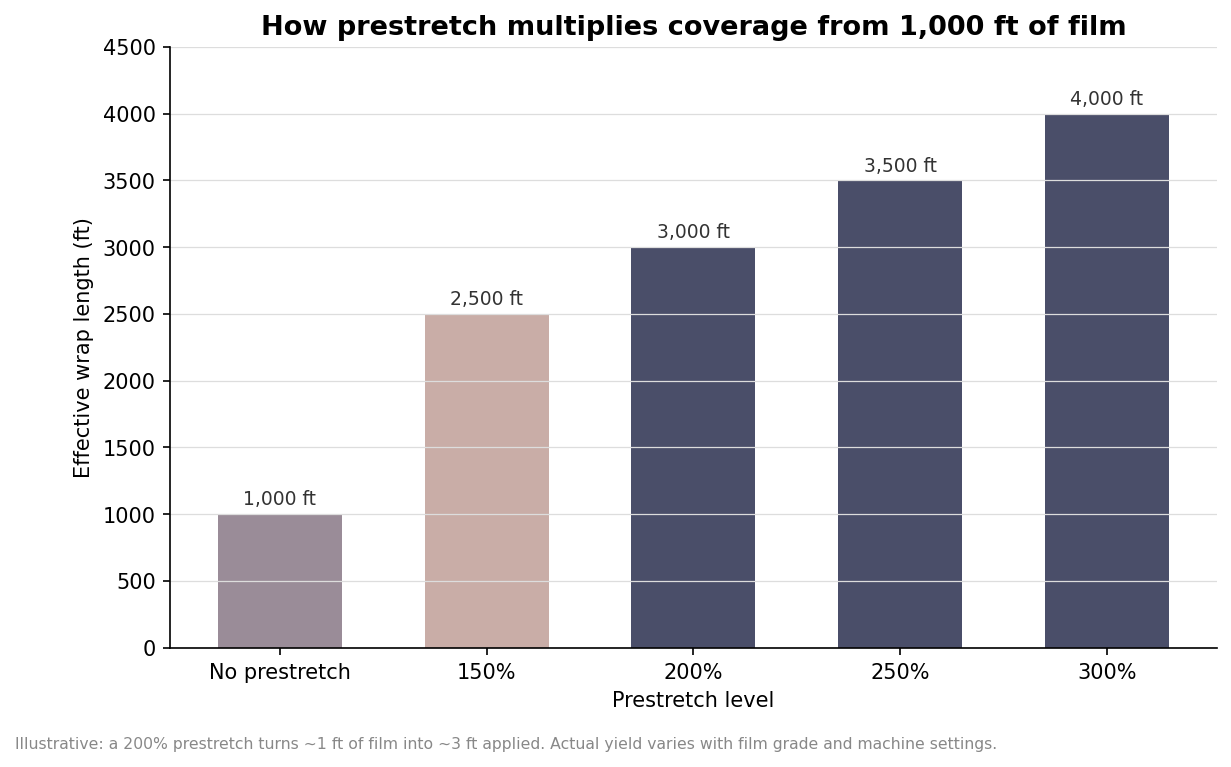
    Prestretch is where wrapping quality meets cost. Prestretched film has already been elongated so that a foot of film off the roll covers far more than a foot of load, which lowers the amount of resin you buy for the same containment. A film applied at roughly 200 percent prestretch turns about one foot into three feet applied, and higher levels stretch it further still. The chart below shows how coverage from a fixed length of film multiplies as prestretch rises. The figures are illustrative, because real yield depends on the film grade and, on powered equipment, the machine’s prestretch setting, but the direction is real: crews that underuse prestretch quietly pay for film they could have saved.

    Bar chart showing effective wrap coverage in feet from 1,000 feet of film at prestretch levels from none to 300 percent
    Higher prestretch stretches the same film further, lowering the resin you buy per pallet.

    The practical takeaway is to match film and method to the load. Hand rolls suit low volume and light loads; a semi-automatic or automatic wrapper with powered prestretch pays off once you are wrapping many pallets a day, both in consistency and in film saved.

    The mistakes that cause most claims

    A handful of errors account for the majority of failed loads. Not tying the film to the pallet base lets the whole load walk off the deck; too few base wraps do the same. Skipping the top overwrap leaves the highest boxes free to topple, and leaving vertical gaps between passes creates weak bands that split under load shift. Wrapping over an overhanging carton invites tears, and pulling so hard that boxes crush is as much a defect as wrapping too loosely. Before releasing a pallet, walk around it and check that the base is locked to the deck, the overlap is consistent top to bottom, the top edge is captured, and the film is taut without deforming the boxes. Those few seconds of inspection are far cheaper than a rejected shipment or a freight claim.

  • A 3PL’s Guide to Pallet Wrap Margins & Freight Claims — Custom Pallet Wrap

    Call or Text us: (929) 605-4397

    HomeBlog › A 3PL's Guide to Pallet Wrap Margins & Freight Claims

    3PL

    A 3PL’s Guide to Pallet Wrap Margins & Freight Claims

    06/30/2026

    Most 3PLs price pallet wrap as a pass-through cost — a line item on the invoice with no margin built in. That leaves real money on the table, because branded wrap does two things a blank roll can’t: it reduces the freight claims that eat into your margin elsewhere, and it becomes a billable, differentiated service instead of a commodity supply cost.

    The freight claims connection

    A load that arrives loose, shifted, or damaged generates a claim — and claims cost a 3PL far more than the wrap itself, in adjuster time, client relationship strain, and sometimes direct reimbursement. Properly gauged, properly tensioned stretch wrap is one of the cheapest levers available to reduce load-shift damage before it happens.

    Turning wrap into a margin line, not a cost line

    Once you’re printing client-branded or house-branded wrap, it stops being an interchangeable commodity and becomes a value-added service you can price accordingly — the same logic packaging distributors have used with branded boxes and mailers for years.

    Order sizeRelative cost*
    12 rollsHighest tier
    100 rollsMid tier
    500 rollsLow tier
    1,000+ rollsLowest tier

    *Estimates only, illustrative of typical volume pricing — request a quote for your exact specs.

    Client retention as a second return

    A client who sees their own logo wrapped around every outbound pallet gets a small, repeated reminder that a specific 3PL is handling their freight — a soft but real retention signal in a category where switching costs are otherwise low.

    Setting your markup

    A simple approach: price wrap as a service line at a modest markup over your landed cost, and let the reduced claim rate and improved retention offset any resistance to the line item. Over a full year of volume, the packaging premium is almost always smaller than the value it returns.

    Key takeawayBranded pallet wrap reduces freight-claim exposure and converts a pass-through cost into a billable, margin-positive service line.

    Ready to add branded wrap to your service offering? Get a custom quote — free mockups in 24 hours. Learn more about how we work, or browse more guides.

    More posts

  • How to Order Custom Pallet Wrap: A Step-by-Step Checklist — Custom Pallet Wrap

    Call or Text us: (929) 605-4397

    HomeBlog › How to Order Custom Pallet Wrap

    Ordering

    How to Order Custom Pallet Wrap: A Step-by-Step Checklist

    05/26/2026

    Ordering custom pallet wrap for the first time involves more decisions than ordering a blank roll off a shelf — but none of them are hard if you work through them in order. Here’s the checklist we walk every new account through.

    1. Confirm your wrap format

    Are you wrapping by hand or feeding a machine? This decision alone determines roll length and core size — a Hand Stretch Wrap Roll for manual dispensers, a Machine Stretch Wrap Roll or Extended Core Jumbo Roll for automatic wrappers.

    2. Pick your gauge

    80-gauge covers most general loads. Go lighter for uniform, high-volume cartons, or heavier for irregular and sharp-edged freight. See our gauge comparison guide if you’re unsure.

    3. Choose color and opacity

    Clear film shows the load and works for most branding needs; opaque film conceals contents for high-value or confidential inventory; high-visibility tints flag oversized or hazard-lane loads.

    4. Send your logo and colors

    Vector files (AI, EPS, SVG, PDF) print cleanest. No vector file? Send a photo or PNG and our designers will recreate it print-ready at no charge.

    5. Estimate your quantity

    Our minimum is just 12 rolls. Estimate based on your current monthly pallet-wrapping volume — we’ll help you right-size the order on the quote call.

    StepWhat we need from you
    FormatHand or machine, dispenser or wrapper model
    GaugeLoad weight and type (uniform vs. irregular)
    ColorClear, opaque, or high-visibility
    ArtworkVector file, or photo/PNG for our designers to recreate
    QuantityApproximate rolls per month or per order

    6. Approve your mockup and place the order

    We return a photo-real mockup within 24 hours. Revise it free until it’s right, then approve and pay to start production — standard runs ship in 2 weeks (faster turnaround available with express shipping).

    Key takeawayNail down format, gauge, color, and artwork before you request a quote, and your first order moves from mockup to delivery in about three to four weeks total.

    Ready to start? Get a custom quote — free mockups in 24 hours. Learn more about how we work, or browse more guides.

    More posts

  • 60-Gauge vs. 80-Gauge vs. 100-Gauge Stretch Film: A Durability Comparison — Custom Pallet Wrap

    Call or Text us: (929) 605-4397

    HomeBlog › 60-Gauge vs. 80-Gauge vs. 100-Gauge Stretch Film

    Buyer guides

    60-Gauge vs. 80-Gauge vs. 100-Gauge Stretch Film: A Durability Comparison

    05/08/2026

    Gauge is the single biggest lever in how a pallet wrap performs — and the easiest spec to get wrong if you’re ordering by habit instead of by load. Here’s a straightforward comparison to help you land on the right thickness before you commit to a print run.

    What gauge actually measures

    Gauge refers to film thickness, measured in ten-thousandths of an inch. Lower gauge means thinner, more economical film with more length per pound; higher gauge means thicker film with more puncture resistance and load-holding strength, at a higher material cost per roll.

    GaugeBest forTrade-off
    60-gaugeLight, stable, uniform loads (boxed goods under ~1,500 lbs)Lower puncture resistance; not for sharp-edged or heavy loads
    80-gauge (our standard)Most general warehouse, manufacturing, and food/beverage loadsBalanced cost and performance for the widest range of uses
    100-gaugeHeavy, irregular, or sharp-edged loads (machinery, building materials)Higher material cost per roll; typically hand-wrap only

    Why we standardize on 80-gauge

    Across manufacturers, warehouses, food producers, and logistics companies, 80-gauge blown or cast LLDPE film handles the overwhelming majority of pallet loads without over-spending on material you don’t need. It holds cling and containment on mixed case-good loads, resists the punctures common in warehouse handling, and prints cleanly under both hand and machine tension.

    When to go lighter or heavier

    If you’re wrapping uniform, lightweight, well-palletized cartons at high volume, a 60-gauge film can reduce material cost without sacrificing containment. If you’re wrapping irregular loads with sharp corners — lumber, metal stock, machinery parts — a 100-gauge film resists tears that would compromise a lighter roll.

    Blown vs. cast at any gauge

    Independent of gauge, cast film offers a quieter unwind and higher clarity; blown film offers higher tear resistance and better memory (it holds tension better over time). We help you choose both dimensions — gauge and film type — based on your actual load profile.

    Key takeaway80-gauge film is the right default for most operations; step up to 100-gauge for heavy or sharp-edged loads, or down to 60-gauge for light, uniform, high-volume runs.

    Not sure what gauge fits your load? Get a custom quote and describe your typical pallet — free mockups in 24–48 hours. Learn more about how we work, or browse more guides.

    More posts

  • Custom Pallet Wrap for Food & Beverage Producers — Custom Pallet Wrap

    Call or Text us: (929) 605-4397

    HomeBlog › Custom Pallet Wrap for Food & Beverage Producers

    Food & Beverage

    Custom Pallet Wrap for Food & Beverage Producers

    04/19/2026

    Case goods leaving a food or beverage plant face two separate risks on the way to a distributor or retailer: physical damage from handling, and contamination or moisture exposure from the environment they pass through. Stretch wrap addresses both, and a printed version does a third job most producers underuse — it identifies the load as yours at every stop between the plant and the shelf.

    Protection that actually matters for case goods

    Our 80-gauge blown or cast LLDPE film holds a pallet load tight enough to prevent shifting in transit, resists punctures from case corners and shrink-wrap edges, and creates a barrier against dust and ambient moisture during storage and transport — all standard performance requirements before you even consider printing.

    Why branding the wrap matters for food and beverage specifically

    Food and beverage pallets move through more hands than most: your dock, a freight carrier, a distributor’s warehouse, and a retail backroom before anything reaches a shelf. A printed wrap keeps your brand visible at every one of those handoffs, which matters for co-manufactured or private-label lines where the finished product itself might not carry your name until it’s unpacked.

    Color-coding for product lines or allergens

    Some producers use a distinct print color per product line or per allergen classification, so receiving staff at a distributor can visually separate pallets before they’re broken down — a small but meaningful reduction in cross-contamination risk during warehouse handling.

    Use caseRecommended film
    Standard case goods, visible brandingHand or Machine Stretch Wrap Roll, clear with print
    Private-label / co-pack separationColored Opaque Wrap, per-client tint
    High-volume bottling or canning linesExtended Core Jumbo Roll

    Getting started

    Tell us your typical pallet weight, case configuration, and whether you need food-contact-safe film specs documented for your quality team — we’ll recommend a gauge and format before you commit to a print run.

    Key takeawayBranded pallet wrap protects food and beverage case goods from damage and contamination while keeping your brand visible at every handoff from plant to shelf.

    Ready to protect your next production run? Get a custom quote — free mockups in 24–48 hours. Learn more about how we work, or browse more guides.

    More posts

  • Hand Wrap vs. Machine Wrap: Choosing the Right Stretch Film — Custom Pallet Wrap

    Call or Text us: (929) 605-4397

    HomeBlog › Hand Wrap vs. Machine Wrap

    Buyer guides

    Hand Wrap vs. Machine Wrap: Choosing the Right Stretch Film

    04/01/2026

    The question isn’t which stretch film is better — it’s which format matches how your dock actually wraps pallets today, and at what volume a machine starts paying for itself.

    Here’s how to think about the choice before you order your first custom roll.

    Hand stretch wrap: flexible, low commitment

    A Hand Stretch Wrap Roll works with a simple dispenser and a person walking the pallet. It requires no capital equipment, adapts instantly to odd-shaped or mixed loads, and is the obvious starting point for lower-volume docks or operations wrapping a wide variety of pallet sizes and shapes day to day.

    Machine stretch wrap: consistency at volume

    A Machine Stretch Wrap Roll is built for a turntable or rotary-arm wrapper that applies tension mechanically. The film runs at a higher, more consistent pre-stretch ratio, meaning each roll effectively covers more pallets than its raw footage suggests, and every load comes out wrapped identically regardless of who’s on shift.

    FactorHand wrapMachine wrap
    Equipment neededSimple dispenserTurntable or rotary-arm wrapper
    Roll length1,000–1,500 ft5,000–8,000+ ft
    Best forMixed, lower-volume loadsConsistent, high-volume runs
    Labor per palletHigherLower

    Where the crossover point is

    Most operations start considering a machine once they’re consistently wrapping more than roughly 40–50 pallets a day — the labor time saved starts to outweigh the equipment cost. Below that, hand wrap with a good dispenser is usually the more economical choice.

    Printing considerations for each

    Both formats take the same flexo-printed logo, but a machine roll’s print repeat is calibrated to the wrap pattern of your specific machine, so send us your equipment details when you request a mockup.

    Key takeawayHand wrap suits lower-volume, mixed-load docks; machine wrap pays off once you’re consistently wrapping 40+ pallets a day. Both print the same branded way.

    Not sure which fits your dock? Get a custom quote and tell us your volume — free mockups in 24–48 hours. Learn more about how we work, or browse more guides.

    More posts

  • A Warehouse Manager’s Guide to Branded Pallet Wrap — Custom Pallet Wrap

    Call or Text us: (929) 605-4397

    HomeBlog › A Warehouse Manager's Guide to Branded Pallet Wrap

    Warehousing

    A Warehouse Manager’s Guide to Branded Pallet Wrap

    03/15/2026

    Walk any multi-client warehouse floor and you’ll see the same problem solved a dozen sloppy ways: masking tape flags, hand-written cardboard signs, colored zip ties. Every one of them is a workaround for something a printed pallet wrap solves permanently — visual identification of whose load is whose, at a glance, from across the floor.

    For a warehouse or 3PL, custom-printed wrap is not just a marketing nicety. It is a sorting tool, a client-facing brand signal, and in a lot of operations, a small but real reduction in mis-picks and mis-ships.

    Why generic clear wrap creates work

    Unbranded wrap makes every pallet look the same until someone reads the label taped to the side — which means a forklift operator has to get close, stop, and check before moving anything with confidence. On a busy floor handling several client accounts, that friction adds up across hundreds of moves a day.

    What a printed wrap solves

    A distinct, printed wrap pattern is visible from the end of an aisle. Color-coding by client or by SKU category lets staff sort visually before they’re close enough to read a label, and it gives drivers and receiving staff at the destination an instant confirmation that they’re looking at the right load.

    ApproachSort speedBrand value
    Unbranded clear wrap + paper labelSlow — requires close readingNone
    Tape flags / zip tiesMedium — color-coded but manualNone
    Custom printed pallet wrapFast — visible at a distanceHigh — travels with every shipment

    Rolling it out without disrupting operations

    Most warehouses start with one or two SKUs of printed wrap — often a house color for internal stock and a second print for a top client account — before expanding to a full client-by-client program. Because our rolls fit standard hand dispensers and stretch wrap machines, there’s no equipment change required to start.

    Choosing your format

    Hand-wrapped docks should start with a standard Hand Stretch Wrap Roll; high-volume automatic lines should look at a Machine Stretch Wrap Roll or, for multi-shift operations, an Extended Core Jumbo Roll to reduce changeovers.

    Key takeawayPrinted pallet wrap turns an anonymous load into a visually identifiable one — faster sorting on the floor, and a brand impression that travels to every dock it touches.

    Ready to put your brand on every pallet? Get a custom quote — free mockups in 24–48 hours. Learn more about how we work, or browse more guides.

    More posts