Two rolls of stretch film can look identical on the rack and behave nothing alike once they hit a load. The difference usually comes down to how the film was made. Cast and blown are the two manufacturing methods behind nearly all pallet wrap, and the choice between them decides how well a load holds, how the film sounds coming off the roll, whether a scanner can read a label through it, and how much you spend per pallet. Understanding the two processes is the difference between buying film by price alone and buying the film your loads actually need.
Two ways to make the same-looking film
Cast film is extruded through a flat slot die and cooled quickly against a chilled roller. That rapid, even cooling produces film with consistent thickness, high clarity, and a quiet, easy release from the roll. Blown film is made by forcing molten resin through a circular die and inflating it into a vertical bubble that cools in the air. The slower, less controlled cooling scrambles the polymer structure in a way that makes the finished film tougher, but also hazier, noisier, and more expensive to produce because the line runs slower.
Neither process is a premium or budget version of the other. They are different tools. Cast dominates the market, by many industry estimates something like seventy to eighty percent of stretch film sold, largely because it runs cheaply at high speed and suits automated wrapping. Blown holds its ground wherever raw toughness and load retention matter more than clarity or cost. The rest of the decision follows from those origins, because almost every property that separates the two films on the loading dock traces directly back to how the polymer cooled when it was made.
It is worth naming the properties that matter before comparing them, because a spec sheet rarely spells them out. Puncture and tear resistance govern whether the wrap survives a sharp corner. Holding force, sometimes called load retention, is how firmly the film pulls a load together and keeps it there through handling and transit. Clarity decides whether labels scan through the wrap. Unwind noise and hand feel affect operators on long shifts. And stretch yield, how far the film elongates before it fails, quietly sets how many pallets a roll actually wraps. Cast and blown land differently on every one of these.
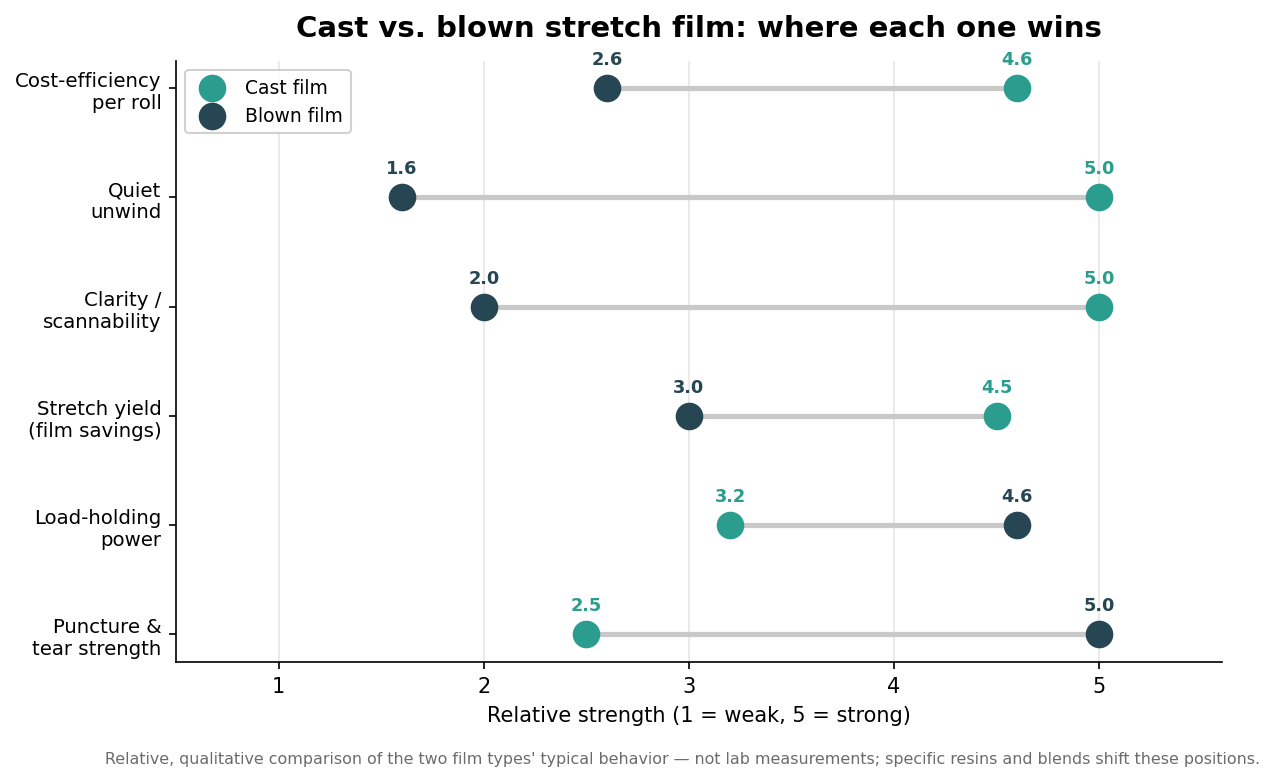
What each film does better on the load
Blown film’s headline strength is strength itself. Its molecular structure gives it superior puncture and tear resistance, so it stands up to sharp corners, exposed hardware, lumber, and irregular loads that would tear cast film under tension. It also has more holding power and memory: once applied it resists re-stretching and pulls back against a shifting load, which is why it is favored where stability is critical. Its cling is typically one-sided, so wrapped pallets do not stick to each other in transit, an underrated advantage when loads are staged tightly.
Cast film answers with clarity, quiet, and yield. It comes off the roll crystal clear, so barcodes and labels stay scannable through the wrap without cutting into it. It unwinds quietly, which matters in noise-sensitive shifts and reduces operator fatigue during long hand-wrapping runs. It usually carries two-sided cling, which helps layers grip themselves as they overlap. And it stretches further before failing, which, as the next chart shows, is where a lot of the real cost lives.
Why stretch yield quietly controls the cost
The sticker price of a roll is only part of what film costs. The bigger number is how many pallets that roll wraps, and that is governed by how far the film stretches. Because the amount of film needed to cover a load falls roughly as one divided by one plus the stretch ratio, pushing film from no stretch to 150 percent cuts the linear film per pallet to around 40 percent of the unstretched amount, and reaching 250 percent cuts it to under 30 percent. Cast film’s greater stretchability is what lets a warehouse chase those higher numbers, especially with powered pre-stretch equipment.
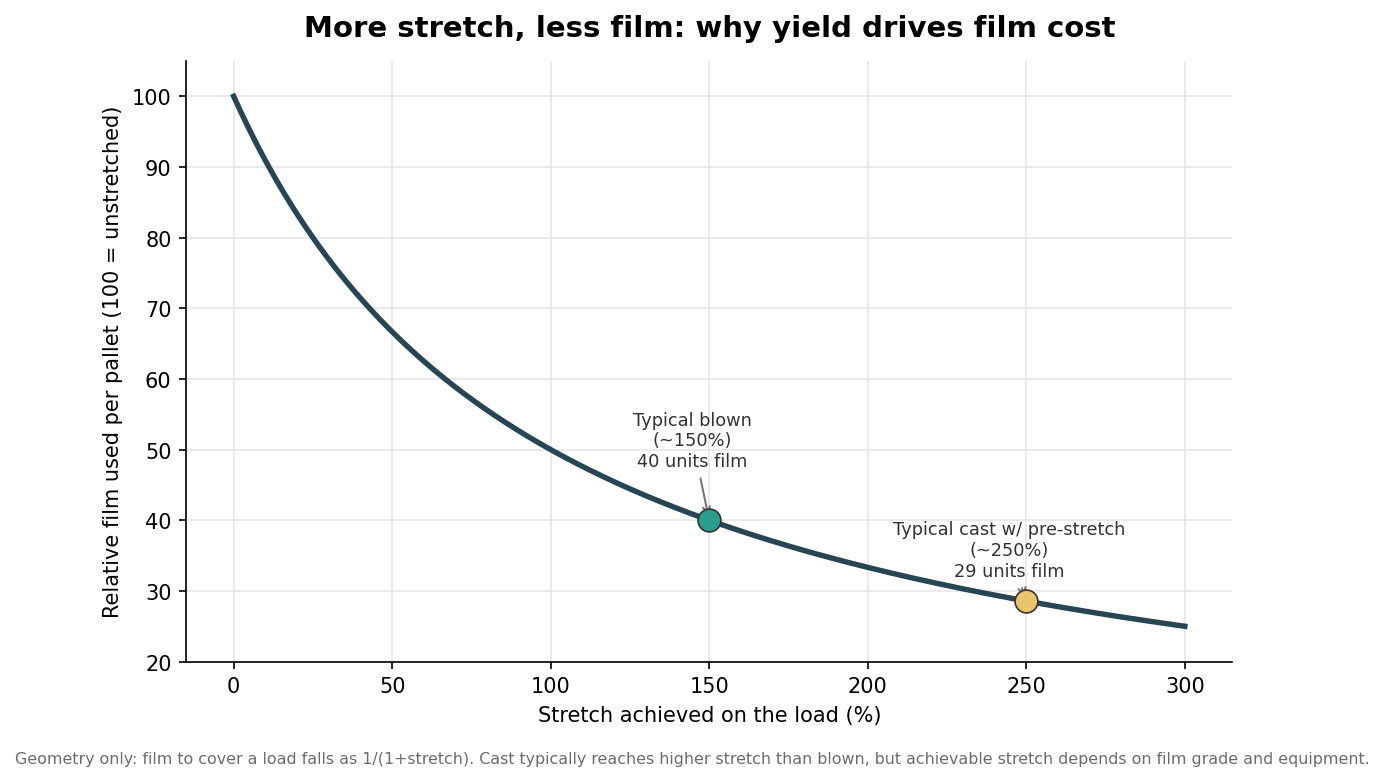
The figures above are geometry, not a promise: the curve describes how film coverage scales with stretch, but the stretch a given film can actually achieve depends on its grade, its thickness, and the machine applying it. The practical lesson holds regardless. A cheaper roll that cannot stretch as far can easily cost more per pallet than a pricier roll that does, because you wrap fewer loads from it. Comparing film on price per roll rather than cost per pallet is the most common way warehouses overpay, and it usually favors the wrong film.
How to specify the right one for your loads
Start from the load, not the film. If your pallets have sharp edges, heavy or dense contents, or irregular shapes that concentrate stress, blown film’s puncture resistance and holding power are worth its higher price and its noise, because a single failed wrap and a toppled load costs far more than the film. If your loads are uniform, stable, and boxed, and especially if labels need to be scanned through the wrap or you are running an automated wrapper, cast film’s clarity, quiet unwind, and higher stretch yield make it the more economical and practical choice for the majority of general warehousing.
Two habits sharpen the decision. Compare candidates on cost per wrapped pallet rather than price per roll, factoring in the stretch each film reliably reaches on your equipment, and match the gauge to the load weight rather than defaulting to the thickest film on hand. Get the process and the yield right and the film line stops being a commodity purchase and becomes a lever on both load integrity and freight cost. The specific stretch numbers and market shares here are indicative and worth confirming against current supplier data, but the underlying trade-off, toughness versus clarity, cost, and yield, is stable enough to build a specification around.
Leave a Reply