A pallet that arrives leaning, shifted, or collapsed is rarely the fault of the film. It is almost always the fault of how the film was applied. Stretch wrapping looks like the simplest job on the dock, which is exactly why it gets done badly: too few turns at the base, no real tension, and a load that separates from the pallet the first time a forklift stops short. Wrapping a pallet correctly is a repeatable technique, and once a crew learns it, damage claims and reruns drop noticeably. Here is how to do it properly, plus the two numbers that decide whether a load actually holds.
Start with a stable load, not the film
No amount of wrapping rescues a badly built stack. Build the load square, with the heaviest and largest boxes on the bottom and lighter items on top, and keep every box inside the footprint of the pallet. Overhang is the enemy: a carton that hangs past the pallet edge loses its corner protection, and film pulled over that overhang tends to tear. Interlock or column-stack the boxes for stability, fill obvious voids so the load cannot shift into them, and make sure the top is reasonably flat so the film has something to grip. If the load is not stable standing still on the dock, it will not survive being wrapped and shipped.
The wrap, step by step
Begin at the bottom. Anchor the film to the pallet by threading a corner of the sheet through the pallet or twisting it into a rope and tucking it in, so the wrap is tied to the pallet itself rather than just to the boxes. This first connection is what stops the load from sliding off the deck in transit. Wrap the base three to four full revolutions, keeping the film low enough to catch the pallet, because the bottom wraps do most of the work of holding the load down.
From there, spiral upward in overlapping passes, letting each layer cover about 50 percent of the one below it so there are no unwrapped bands. Keep steady tension the whole way up; on a manual roll, starting around 50 percent of the film’s stretch is a reasonable default, dropping toward 20 percent when the boxes are crushable. When you reach the top, put two to three revolutions around the uppermost layer and carry three to six inches of film over the top edge of the boxes to lock the crown of the load. Then spiral back down to reinforce and return to the base, and tuck or twist off the tail rather than letting it flap loose. For heavier or taller loads, twisting the film into a rope for a pass or two, sometimes called roping or cabling, concentrates the force and pulls the top of the load in tight.
Containment force: the number that decides if it holds
The single most useful concept in pallet wrapping is containment force, and most people have never measured theirs. Containment force is the total holding force the film applies to the load, measured in pounds, and it equals wrap tightness multiplied by the number of revolutions at a given point on the load. Two turns of tight film and four turns of loose film can produce completely different results, which is why “just wrap it a few times” is not a spec.
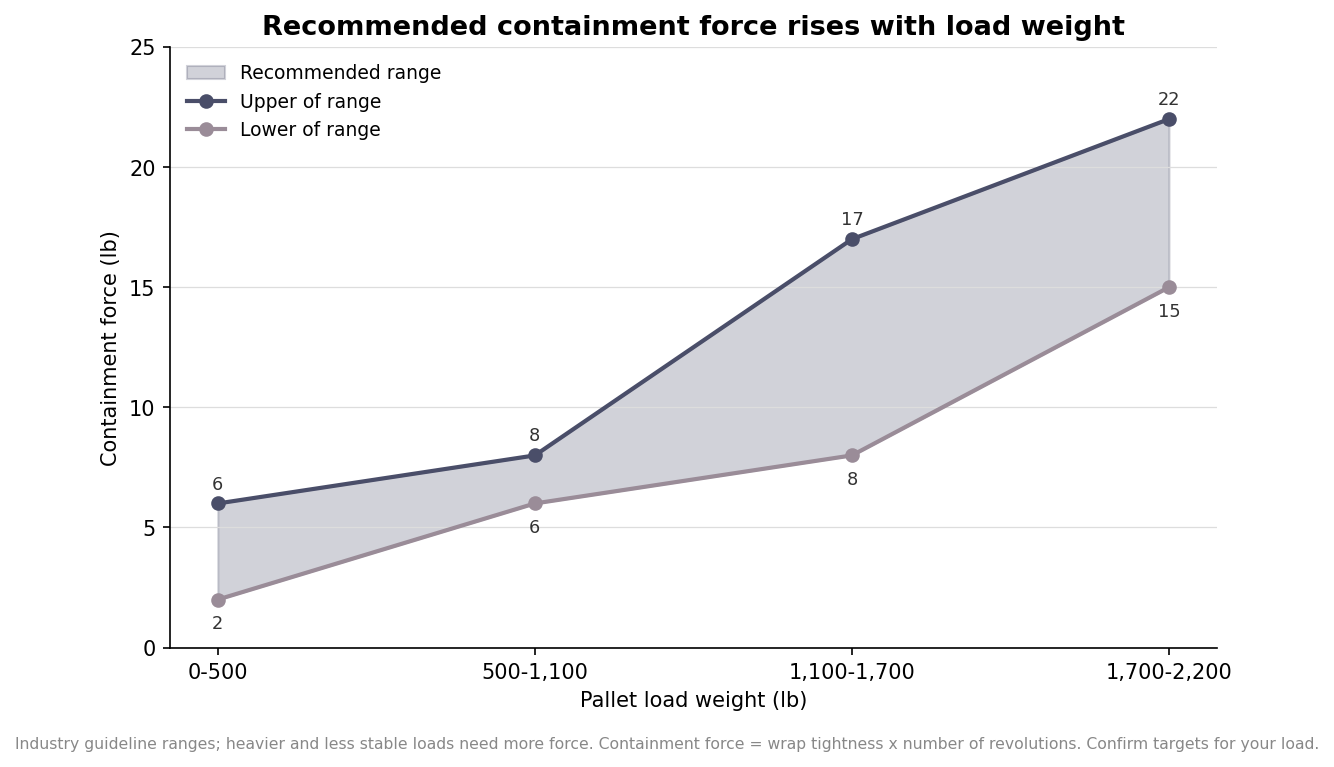
How much you need scales with the weight and stability of the load. As a rough industry guideline, light loads up to about 500 pounds call for roughly 2 to 6 pounds of containment force, standard loads in the 500-to-1,100-pound range want about 6 to 8 pounds, heavier loads up to 1,700 pounds want 8 to 17 pounds, and very heavy or unstable loads push into the 15-to-22-pound range. The chart below shows how that recommended window climbs with load weight. Treat these as starting points and confirm the right target for your specific product, since a fragile load and a dense, stable one of the same weight behave differently.
Prestretch and the cost of the film you use
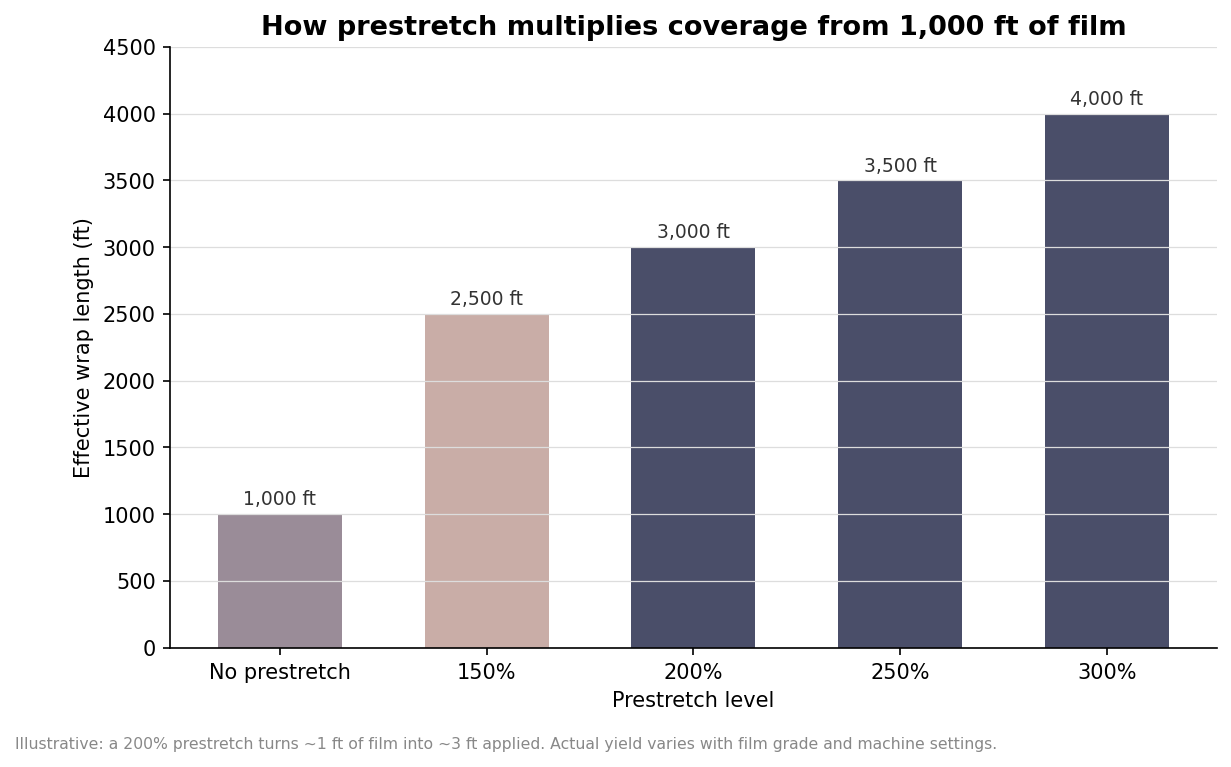
Prestretch is where wrapping quality meets cost. Prestretched film has already been elongated so that a foot of film off the roll covers far more than a foot of load, which lowers the amount of resin you buy for the same containment. A film applied at roughly 200 percent prestretch turns about one foot into three feet applied, and higher levels stretch it further still. The chart below shows how coverage from a fixed length of film multiplies as prestretch rises. The figures are illustrative, because real yield depends on the film grade and, on powered equipment, the machine’s prestretch setting, but the direction is real: crews that underuse prestretch quietly pay for film they could have saved.
The practical takeaway is to match film and method to the load. Hand rolls suit low volume and light loads; a semi-automatic or automatic wrapper with powered prestretch pays off once you are wrapping many pallets a day, both in consistency and in film saved.
The mistakes that cause most claims
A handful of errors account for the majority of failed loads. Not tying the film to the pallet base lets the whole load walk off the deck; too few base wraps do the same. Skipping the top overwrap leaves the highest boxes free to topple, and leaving vertical gaps between passes creates weak bands that split under load shift. Wrapping over an overhanging carton invites tears, and pulling so hard that boxes crush is as much a defect as wrapping too loosely. Before releasing a pallet, walk around it and check that the base is locked to the deck, the overlap is consistent top to bottom, the top edge is captured, and the film is taut without deforming the boxes. Those few seconds of inspection are far cheaper than a rejected shipment or a freight claim.
Leave a Reply