Two warehouses can wrap identical pallets, buy film at the same price per pound, and end up with monthly stretch-film bills that differ by a third. The variable that usually explains the gap is not the film itself but how far it gets stretched before it touches the load. Pre-stretch is the least glamorous number in the stretch-wrap spec and one of the most financially significant. Understanding it is the difference between buying film and buying the coverage the film can actually deliver.
What pre-stretch actually means
Pre-stretch is the amount film is elongated before it is applied to the load, expressed as a percentage of its original length. A carriage set to 200% pre-stretch takes one foot of film and elongates it to three feet before it wraps the pallet. The film leaves the roll short and thick and arrives on the load long and thin, having done most of its stretching inside the machine rather than by brute tension against the corners of the freight.
This is fundamentally different from simply pulling film tight by hand. Hand-applied conventional film rarely achieves meaningful elongation, because a person cannot generate consistent tension wrap after wrap. A powered pre-stretch carriage, by contrast, stretches the film against a set of geared rollers to a precise, repeatable percentage. That precision is what makes pre-stretch a spec you can actually plan around rather than a variable that drifts with whoever is running the wrapper that shift.
The yield math: one foot off the roll, several feet on the load
The economic case for pre-stretch is pure arithmetic. At 150% pre-stretch, every linear foot coming off the roll becomes about 2.5 feet on the load. At 300%, that same foot becomes roughly 4 feet. In other words, raising pre-stretch from 150% to 300% lets one roll cover substantially more pallets before it runs out, because you are drawing far less film off the core to deliver the same wrap.
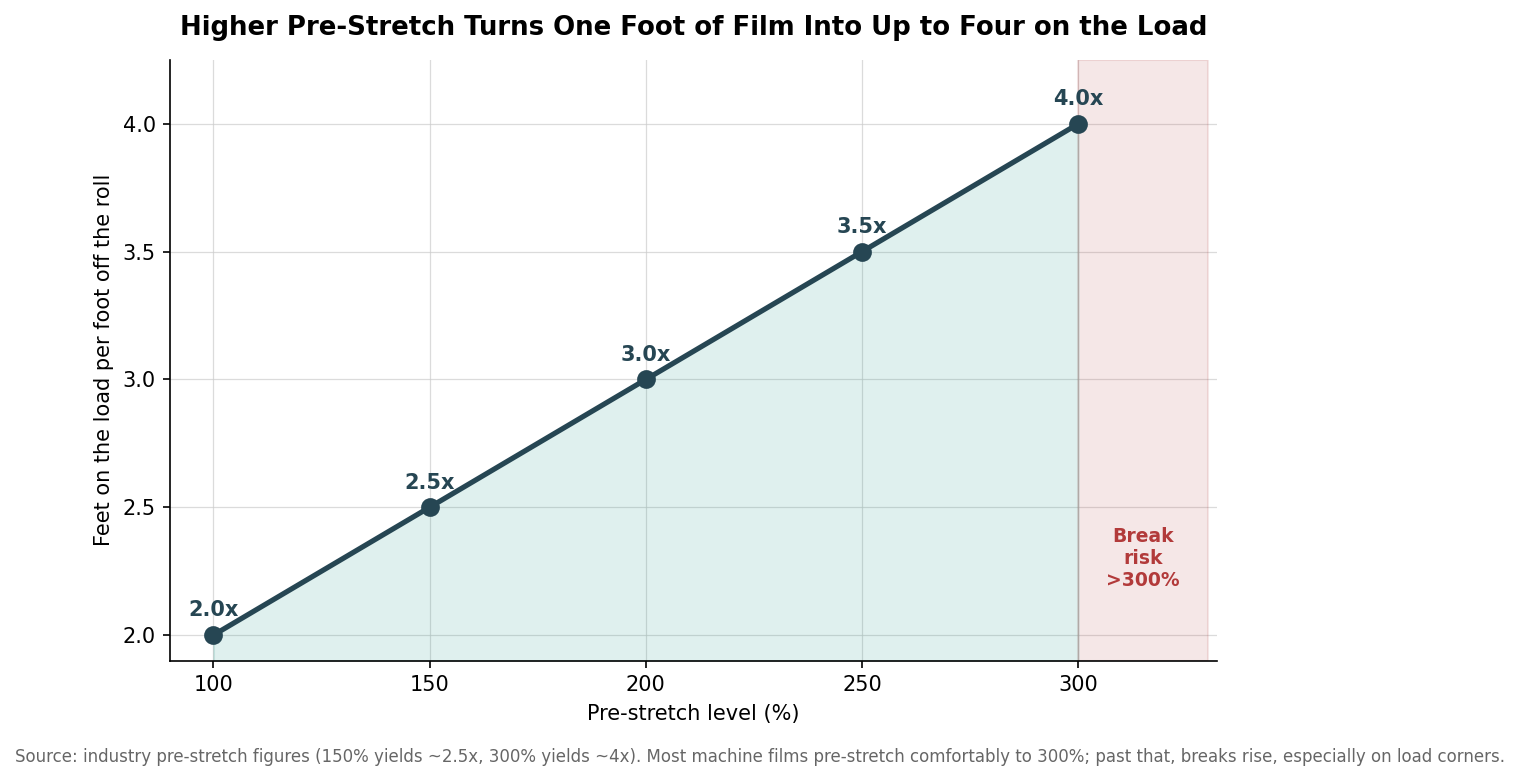
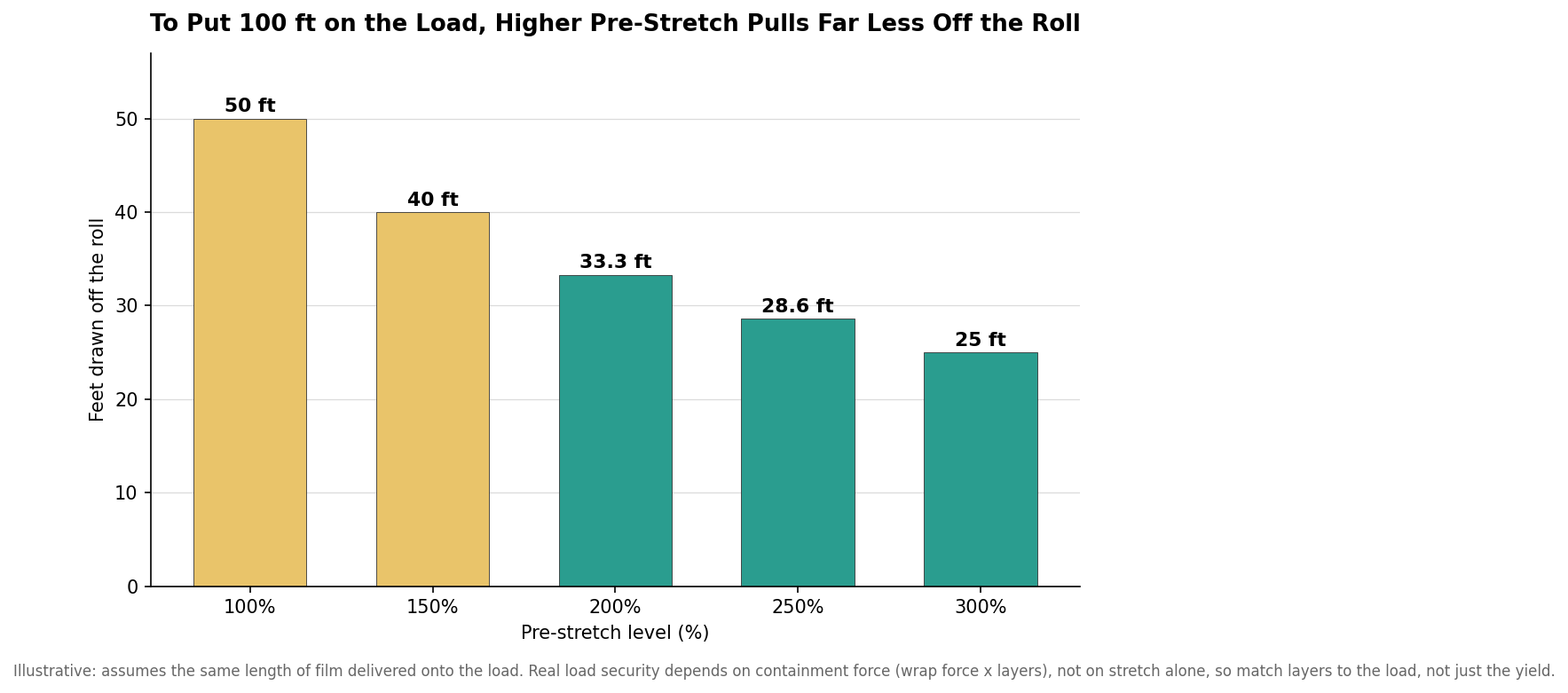
Flip the arithmetic around and the purchasing implication becomes obvious. To lay a given length of film onto a load, a higher pre-stretch level pulls dramatically fewer feet off the roll. The second chart shows the same relationship from the buyer’s side: putting a fixed amount of film on the load costs 50 feet off the roll at 100% pre-stretch but only 25 feet at 300%. Since you pay for the feet on the roll, not the feet on the load, that is where the savings live. Across a facility wrapping hundreds of pallets a day, moving up the pre-stretch curve is commonly cited as cutting film consumption by 20% to 30%.
Where the 150 to 300 percent range comes from
Most machine films sold today are engineered to pre-stretch comfortably up to 300%. The usable band runs from roughly 150% at the conservative end to 300% at the aggressive end, and the setting is typically fixed by the gears in the wrapper’s pre-stretch carriage rather than dialed in by the operator. Films are formulated with the resins and layer structure needed to survive that elongation without necking down to the point of tearing.
There is a ceiling, and it is real. Push past 300% and film begins to break more often, particularly at the corners of the load, where a pre-stretched web is already near the limit of its tension and the geometry concentrates stress. Chasing an extra few points of yield at 320% or 340% tends to backfire: a film break mid-cycle stops the line, leaves a partially wrapped pallet, and wastes the film already applied. The practical target for most operations is to run the highest pre-stretch the film and load will tolerate reliably, then stop, rather than to maximize the number on paper.
The catch: pre-stretch saves film, containment force secures the load
Here is the nuance that trips up buyers who treat pre-stretch as a proxy for load security. Stretching the film is not what holds the load together. Load stability is governed by containment force, which is the product of wrap force and the number of film layers. A tightly pre-stretched single layer and a moderately stretched double layer can deliver the same containment force, and it is that force, applied through enough revolutions, that keeps boxes from shifting in transit.
What pre-stretch does is let you reach a given containment force using less film mass, because the thinned, elongated film still contributes wrap force per layer. The mistake is assuming that maxing out pre-stretch automatically produces a secure pallet. If you thin the film aggressively but do not apply enough wraps, you can end up with a beautifully economical wrap job that fails a freight-claim test. Pre-stretch is a cost lever; layer count and wrap force are the security levers, and they have to be set together.
How to choose a pre-stretch level and spec film for it
Start from the load, not the yield target. A light, stable, boxy pallet tolerates high pre-stretch and few layers, so it is the ideal candidate for pushing toward 250% or 300% and capturing the film savings. A heavy, unstable, or sharp-cornered load needs more containment force and often a tougher film, which may mean running pre-stretch a notch lower to preserve puncture resistance and avoid breaks at the edges. Match the film’s rated pre-stretch capability to the setting on your carriage; a film formulated for 200% will not survive a 300% carriage, and running a high-performance film at a low setting leaves savings on the table.
When you specify film, ask for its recommended pre-stretch range and its performance at that range, not just its gauge or micron rating. A thinner film run at high pre-stretch can outperform a thicker film run poorly, because effective performance comes from how the film is applied as much as from how much material is in it. Set the carriage to the highest level the load runs reliably, confirm containment force with enough wraps to pass your own drop or tilt test, and let the yield math do the rest. Done deliberately, pre-stretch is the rare packaging decision that cuts cost and improves consistency at the same time.
Leave a Reply